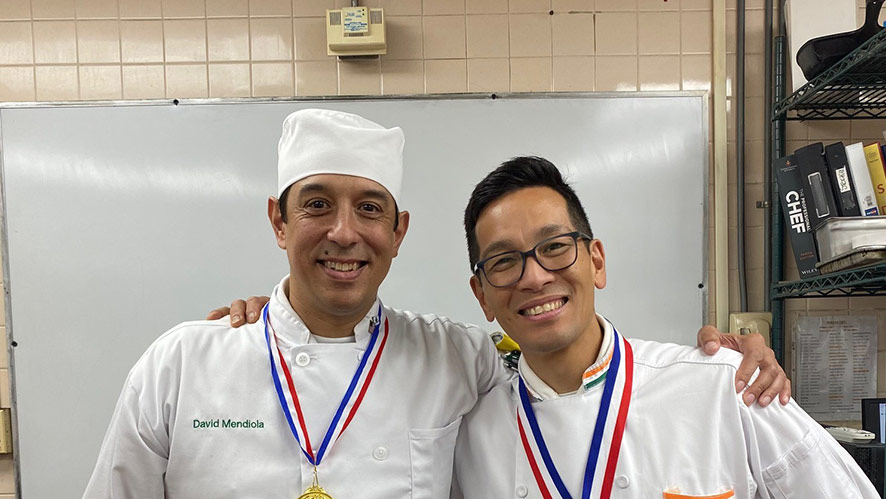
Key Takeaways:
- A return to his culinary roots: After nearly 26 years in the US Army, David Mendiola is pursuing his longtime passion for food through hands-on training at CIA.
- Making the most of veterans’ benefits: GI Bill® benefits helped make CIA’s Culinary Arts associate degree possible. He has also added an associate degree in Baking and Pastry Arts to his educational goals.
- Military experience creates a strong foundation: CIA’s structured classes, high standards, and disciplined chef instructors feel familiar to David and help him build on his military experience while mastering culinary fundamentals.
- Community and new opportunities: Veteran orientation leaders, fellow military-connected students, and supportive staff have helped David transition to student life. He encourages other veterans to use their earned benefits to explore new careers and passions.
Full Circle Journey: From Military Service to the Culinary Path He First Envisioned
Meet David Mendiola, a Culinary Arts associate degree student and US Army veteran. After 25 years of military service, David is returning to the passion for food and hospitality that first inspired him. Now honing his skills in CIA kitchens, he is building a new chapter centered on cooking, travel, and bringing people together through food.
1. What branch of the military did you serve in, and when?
I enlisted in the United States Army in January 1998 and served 25 years, 11 months, and 14 days. I began my career as a Food Service Specialist Military Occupational Specialty (MOS) before later transitioning into administrative roles in the Army National Guard, where I worked across unit, battalion, brigade, and state levels. Over the years, I earned additional MOS qualifications in Human Resources and Infantry and spent much of my career handling personnel support and organizational operations. I retired on December 31, 2023.
2. What inspired you to transition from your prior profession into the culinary field?
Cooking has been part of my story since before high school. My dad—an Army retiree—pointed me toward the Army’s culinary track, and after basic, I went to AIT as a Food Service Specialist (MOS). My first exposure was big‑batch, practical work—the mass‑production basics you learn as a new soldier.
When I finally retired, I wanted to come full circle and get the formal training I’d always imagined at the start. I still loved cooking, and I wanted to be back in a kitchen every day—not just helping here and there, but really building my skills. When I realized my benefits aligned with the associate program at CIA, the path clicked: hands‑on training, a fast, focused curriculum, and exactly the foundation I want for this next chapter.
3. Why did you choose CIA, and why the associate program?
I first heard about CIA years ago through Anthony Bourdain’s Kitchen Confidential, so the school was always on my radar. But it wasn’t until I retired and saw CIA listed in a veterans’ education magazine—fully covered by my benefits—that it really clicked. It felt like the right time to finally chase the culinary path I originally planned on when I joined the Army.
I chose the Culinary Arts associate program because I wanted a solid foundation and a structured way to rebuild my skills. Then once I got here, I heard another veteran talking about doing both culinary arts and baking and pastry arts. I didn’t even know that was possible. The next day I talked to my advisor and added it to my plan.
So now I’m finishing my associate in Culinary Arts and starting my associate in Baking and Pastry Arts in the fall. It just makes sense—I’ve discovered I really enjoy both.
4. At this stage of your life, what career path are you aiming for?
I see myself in Italy. My brigade’s lineage is connected to places like Anzio, Velletri, and Salerno, and I’ve always wanted to visit those towns and send pictures back to my old soldiers and sergeant majors.
But for me personally? I picture a simple, peaceful life—walking down a cobblestone street in a linen suit, maybe a fedora, bread in one hand and a bottle of wine in the other, heading home after a three‑hour shift at a deli. Or maybe working on a vineyard for a few hours a day, getting my hands dirty and enjoying the pace of it all.
At this point in my life, that’s the dream: taking it easy, living well, and enjoying the craft I’ve spent years coming back to. Whatever I do next will be enabled by my experience at CIA.
5. Have you found similarities between military training and the structure of CIA classes?
Yes, for sure. The chefs reminded me a lot of the military—structured, disciplined, and very clear about expectations. You can tell they’ve put in years of work, and that kind of leadership feels familiar.
The classroom environment was a bit of an adjustment just because you’re working alongside people of all different ages and backgrounds. But that’s not a bad thing—it’s just different. Once I realized that my past experience didn’t replace learning the fundamentals here, everything became smoother.
So yes, there are similarities in structure, but a lot of it is just being open, adapting, and learning with everyone around you.
6. How did you find like‑minded people here at CIA?
Orientation helped a lot. CIA had an orientation leader who was a veteran. So, from day one, we were grouped with other veterans and dependents. They helped us connect, share stories, and understand the transition.
Seeing Admissions Counselor Susan Lavender, checking in on us—by email, text, or in person—made a huge difference. And the vets’ lounge in the Student Recreation Center (SRC) gave us a space to talk, decompress, and support each other.
7. What has been your favorite class or hands‑on experience so far?
Garde Manger, hands down. Learning techniques like curing, cold‑smoking, hot‑smoking, and making sausages—it all completely amazed me. I was in awe the whole time, and honestly, I had so much fun. Helping prepare canapés for graduation was also a great experience; those little details really opened my eyes to the craft.
As for mentors, my fundamentals chef, Chef Nitahara ’07/’08, made a big impact. Coming from the military, his structure and expectations felt familiar and helped me transition. And there have been others—Chef Eisenhauer, Chef Ona ’01, Chef Reilly ’88, and of course Chef Ro ’12/’14. All different personalities, but all fair, supportive, and serious about the craft. They really shaped my experience here.
8. Anything you’d say to a veteran considering CIA?
I’d say it’s a great opportunity to do something completely new after spending so many years in the military. And if you’re already interested in the culinary field, then why not? The benefits are there for you. It really is a foolproof plan. It’s something fun and you walk out of here with a degree from one of the most respected culinary schools out there.
On top of that, the campus and the area are beautiful. There’s so much to see and do here, especially if you’ve never lived in this part of the country. I hit the ground running—visited spots I’d always heard about, tried great food, enjoyed the countryside, the seasons, everything. It’s a totally different experience.
So, if you’re considering it, honestly—why not? You’ve earned the benefits, and this is a great way to use them.
Interested in Starting Your CIA Education?
Apply the Post 9-11 GI Bill® and Yellow Ribbon benefits to cover up to 100% of your CIA tuition. You’ll receive support from an admissions counselor who specializes in veteran students.